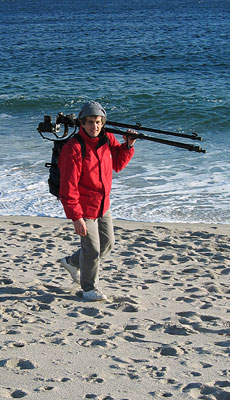
 Photo Isabelle Gliksman |
Before I left to Brittany for a small week break, I discovered the spriteorama, helping Bill Meikle on stitching aspects for his video-panorama project, while he helped me understanding his tool.. Knowing how the thing was working (the Spriteorama technique) i decided to make a try in a nice landscape with something naturally moving... Arrived in Brittany, the first day the sun get out we drove to a beach I knew for its nice rocks. It was really freezing, the sun was low, right in the face when looking at the sea most of the time, not easy conditions though. I did 2 panoramas with animation in the rocks, 2 on the beach, and tried an other with the dog and my wife, but the dog didn't really understood the Spriteorama technique and it was quiet complicated to explain him when he should start and how slow he should move ... I did the panos with my Nikon D1x and a Nikkor 10,5 mm. 4 images used for the panos and 9 for each animation. I have now up-graded the D1x to have the bigger buffer to make more images in the animations ... |
| About spriteoramas: The spriteorama tool allow different kinds of sources, videos, parabolic mirrors images or stitched photos; Bill Meikle is actually working on a nice project with "video panorama". Some have tried before with parabolic mirrors. I preferred to experiment with stitched photos that gives the best image quality . All solutions have their respective advantages: 360° motion and high frame rate for video-panorama, no stitch to do but little resolution and low frame rate with the mirrors, image quality but low frame rate for stitched panoramas. In all case we can have sound embed in the panorama or set externally as it is done here, providing a new degree in the immersive experience. The panoramas shown here are about the third or half the resolution of the master I build (1,6 Megapixels, instead of 9,6 Megapixels). Since there is no zoom (yet) in the spriteorama tool it isn’t necessary to make too big movies for the web. The frame differencing of the Sorenson codec that allows small files is powerfully used here due to original image quality. Thanks to Bill Meikle for his support (http://www.vrhotwires.com)
|
|
 |